

The Ultimate Guide to the Best Portable Chargers for Travel

To find the best portable charger for travel, choose one in the 10,000mAh to 20,000mAh range with fast-charging USB-C Power Delivery. Your goal is to find a model small enough to toss in a bag but powerful enough to recharge your phone multiple times. Use this guide to select a charger that keeps you connected, no matter where your travels take you.
Why a Portable Charger Is Your Most Essential Travel Gadget
We’ve all been there: your boarding pass won't load, your hotel key app is dead, or the map to that amazing restaurant is gone—all because your phone died at the worst possible moment. In today's world, your phone is your travel command center, and letting it run out of power can derail your plans. A reliable portable charger isn't just a gadget; it’s an essential part of your travel kit.
Power-hungry apps like GPS, constant camera use, and searching for a cell signal in a new city can drain your battery in hours. That’s why selecting the right portable charger before you leave is one of the smartest travel preparations you can make.
Understanding the Basics Before You Buy
To pick the right charger, you only need to understand three key specifications. This isn't a tech lecture—it's a practical breakdown to help you find the perfect power bank for your trip.
- Capacity (mAh): Think of milliampere-hours (mAh) as the size of the charger’s fuel tank. A 5,000mAh unit is ideal for a quick top-off, but a 10,000mAh charger will fully refuel most smartphones at least twice.
- Charging Speed (Watts): Wattage (W) determines how fast that fuel gets into your device. To get the fastest charge during a short layover, look for higher wattage, especially with Power Delivery (PD) technology.
- Ports (USB-C vs. USB-A): USB-C is the modern, oval-shaped port essential for faster charging speeds. The older, rectangular USB-A port works but is much slower. To ensure your charger works with all your new gear, make sure it has at least one USB-C PD port.
Our growing reliance on devices has caused the global portable charger market to skyrocket, with projections to grow from USD 9.7 billion to over USD 28.6 billion by 2035. With 70% of travelers now packing a power bank, it's clear these devices have become essential. You can read more about the portable charger market growth and its key drivers.
Actionable Tip: Treat your portable charger like travel insurance against digital disasters. It gives you the freedom to explore without worrying about being cut off from your maps, tickets, and contacts when you need them most.
Once you have these fundamentals down, you can confidently evaluate different models. Whether you need a slim power bank for a weekend city trip or a rugged one for an off-grid adventure, your choice will come down to balancing power, size, and safety.
To see practical, travel-tested options, browse our handpicked collection of essential travel gadgets.
Demystifying Power Bank Specs: mAh, Wattage, and What They Mean for You
Shopping for a portable charger often feels like cracking a code. You see numbers like 10,000mAh and 20W, but what does that mean when you’re stuck in an airport with a dying phone? Let’s translate this tech-speak into practical advice so you can choose the right power bank for your travels.
Think of milliampere-hours (mAh) as the size of the charger's fuel tank. A larger number means more recharges for your devices before the power bank itself needs a wall outlet. It’s the most important indicator of how long your charger will last during a trip.
For example, a pocket-friendly 5,000mAh charger will provide roughly one full charge for a modern smartphone. The popular 10,000mAh size gives you enough power for two or three full charges. If you're traveling with multiple gadgets or a laptop, a 20,000mAh unit is the workhorse you need to stay powered for days.
What Is mAh and How Much Do You Need?
Here’s a practical guide to choosing the right capacity for your travel style:
- 5,000 mAh: Best for a day trip or a night out. It’s light enough to forget it’s in your pocket and gives you a single emergency recharge to get you back to your hotel.
- 10,000 mAh: The perfect balance of power and portability for most weekend getaways. It can easily handle your phone and wireless earbuds without weighing you down.
- 20,000 mAh: The go-to for digital nomads, long-haul travelers, or families. This capacity can recharge a phone several times, power a tablet, and even provide a significant boost to a USB-C laptop like a MacBook Air.
Understanding how capacity, speed, and ports work together is the key to selecting a charger that won’t fail you when you need it most.
Understanding Wattage and Fast Charging
If mAh is the size of the fuel tank, wattage (W) is the speed of the pump. Higher wattage means faster charging—a critical feature when you only have 30 minutes between flights. This is where technology like Power Delivery (PD) becomes essential.
An old-school USB-A port might only deliver 5W to 12W of power. In contrast, a modern USB-C port with PD can push out 18W, 20W, 45W, or even more. This makes a huge difference in real-world use. For today’s traveler, a charger with PD is a must-have.
Actionable Tip: A 20W USB-C PD port can charge a recent iPhone from 0% to 50% in about 30 minutes. A basic 5W port would take over an hour to do the same.
Our dependence on devices is undeniable. With global smartphone use projected to hit 85% by 2026, reliable power is non-negotiable. When you're using power-hungry navigation or streaming apps on the road, your battery can drain 30-50% faster than usual. You can see some of the research on charging trends to understand just how vital these devices have become.
Bottom line: When you shop, look for "PD" or "Power Delivery" next to the wattage on the USB-C port. That’s your guarantee for a charger that can keep up with your travel pace.
Navigating Airline Rules for Portable Chargers
Nothing ruins the start of a vacation like having your gear confiscated by airport security. When it comes to portable chargers, you must know the airline rules to ensure both you and your power bank arrive at your destination safely.
The most important rule is that all portable chargers and power banks must be packed in your carry-on luggage. They are strictly forbidden in checked bags because the lithium-ion batteries inside pose a fire risk. In the cabin, an issue can be dealt with immediately; in the cargo hold, it cannot.
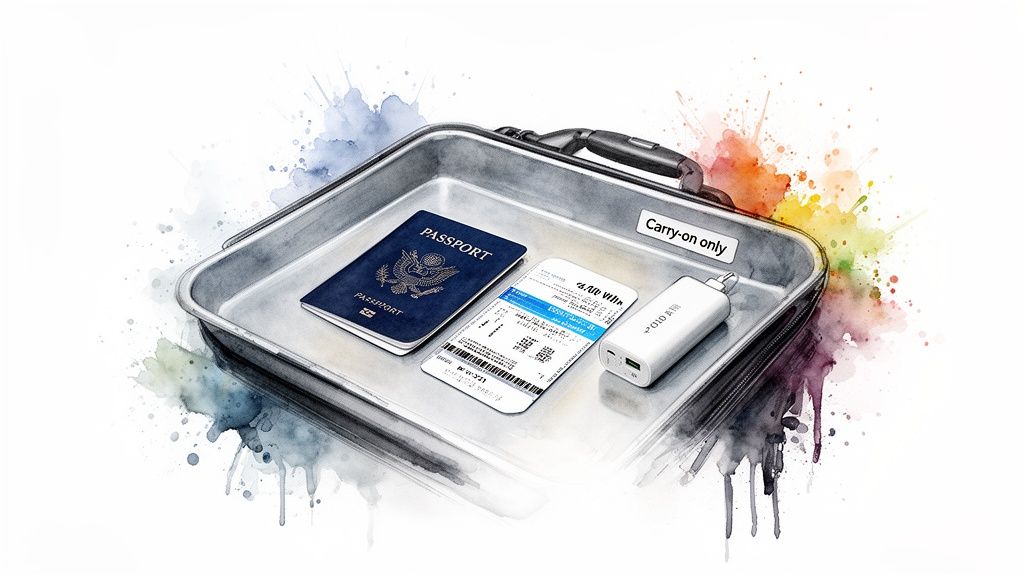
Agencies like the TSA strictly enforce this. Forgetting could lead to delays, a frantic repack at the check-in counter, or losing your charger.
Understanding the 100 Watt-Hour Limit
Airlines also have a power limit measured in Watt-hours (Wh). The key number to remember is 100Wh. Any battery under this limit is generally approved for carry-on.
You can typically bring multiple batteries under 100Wh. For larger batteries between 101-160Wh, you must get airline approval first. Anything over 160Wh is not allowed.
The good news is that most travel chargers fall well below this limit. Even a large 20,000mAh power bank is typically under 100Wh. This rule primarily targets massive, industrial-sized battery packs, not the one you use for your phone.
Not sure about your charger's rating? Most manufacturers print the Wh on the casing. If not, you can calculate it yourself.
The Quick-Check Formula:
(mAh / 1000) x V = WhTo use it, divide the capacity in mAh by 1000, then multiply by the battery’s voltage (almost always 3.7V for these devices). For a 20,000mAh charger, the math is (20,000 / 1000) x 3.7 = 74Wh—well under the limit.
Doing this simple calculation before you pack gives you total peace of mind at the security line.
Certifications and Packing for Safety
When buying a portable charger, look for safety certifications. These logos confirm that the device has been tested to prevent overheating, overcharging, or short-circuiting.
Key certifications to look for include:
- UL (Underwriters Laboratories): A globally recognized gold standard for safety testing.
- CE (Conformité Européenne): Indicates the product meets European safety and environmental standards.
- FCC (Federal Communications Commission): A U.S. certification confirming the device won't interfere with other electronics.
Seeing these on a product means you're getting something reliable.
Finally, pack your charger smartly. To prevent it from accidentally turning on, place it in a protective pouch. For extra safety, put a small piece of electrical tape over the ports to ensure no stray keys or coins in your bag can cause a short circuit. It’s a simple step that makes a real difference.
Choosing the Right Charger for Your Trip and Devices
The best portable charger for a quick business trip is rarely the right choice for a week-long backpacking adventure. To find the perfect match, focus on your specific travel style rather than a one-size-fits-all solution.
A charger is a tool; you need the right one for the job. You wouldn't bring a massive power bank on a short city break, just as a small one wouldn't suffice for an off-grid trek. Matching the charger's features to your itinerary ensures you have exactly what you need.
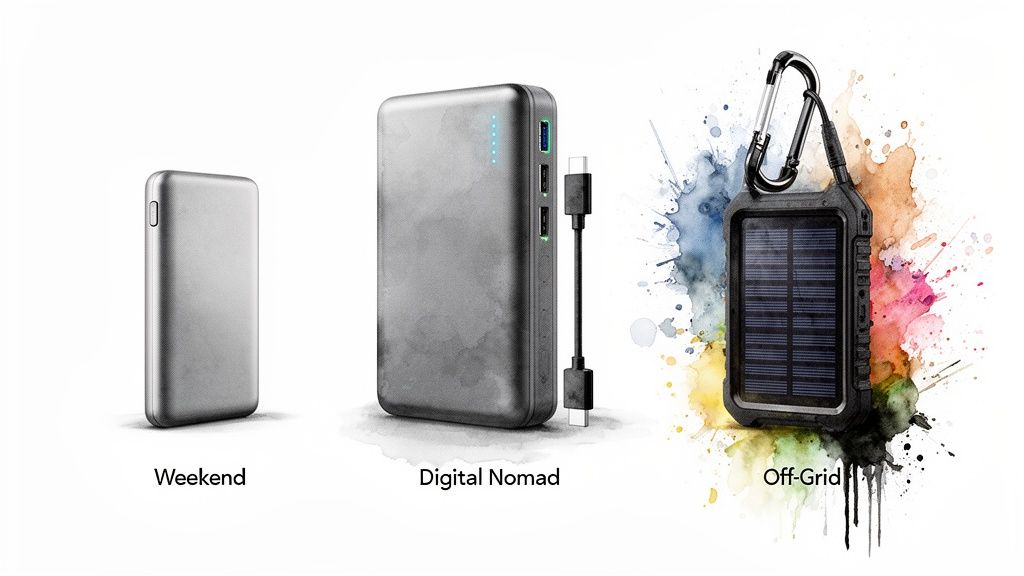
For the Weekend City Breaker
If your trips are short—a weekend exploring a new city or a quick business meeting—prioritize portability. You need a charger that’s light, slim, and disappears into a pocket or small bag.
For this type of trip, a 5,000mAh unit is the perfect companion. It provides about one full charge for a modern smartphone, which is enough to get you through a long day of using maps and taking photos. Look for models with an integrated cable to keep your setup minimal and hassle-free.
For the Digital Nomad and Business Traveler
When travel involves work, your tech needs multiply. You’re powering a laptop, tablet, and headphones—not just a phone. For the digital nomad or frequent business flyer, capacity and versatility are essential.
This is where 20,000mAh+ powerhouses excel. A charger this size can refuel a smartphone multiple times and provide a significant boost to a USB-C laptop. Look for models with multiple ports, including at least one high-wattage USB-C PD port (45W or higher), to handle laptop charging efficiently.
Actionable Tip: Look for pass-through charging. This feature lets you charge the power bank from a wall outlet while it simultaneously charges your devices. It effectively turns one hotel outlet into a multi-device charging station.
For the Off-Grid Adventurer
For hikers, campers, and anyone venturing far from power outlets, reliability and ruggedness are paramount. Your charger becomes a critical piece of safety gear, keeping your GPS and communication devices online.
The off-grid adventurer needs a durable, often water-resistant charger that can handle the elements and is compatible with alternative power sources. Solar compatibility is a game-changing feature for extended trips.
The demand for this kind of resilient power is growing fast. The portable solar charger market is projected to surge to nearly USD 14.7 billion by 2034, driven by adventurers and emergency-prepared travelers. Models with 5,000-10,000 mAh capacity currently dominate the market, powering essential gear like drones and cameras, with an estimated 65% of outdoor travelers prioritizing solar as a reliable backup.
For serious off-grid power, pair a high-capacity power bank with a complementary power source. Investing in a quality foldable portable solar panel provides unlimited energy, turning your power bank into a truly sustainable, off-grid power station.
Feature Checklist for Every Type of Traveler
Use this checklist to quickly compare the essentials and select the perfect charger for your travel style.
| Feature | Weekend City Trip | Business and Digital Nomad | Outdoor Adventure |
|---|---|---|---|
| Capacity (mAh) | 5,000 - 10,000 (for 1-2 phone charges) | 20,000 - 27,000 (for phones, laptops, and more) | 10,000 - 20,000 (balanced for weight and power) |
| Size & Weight | Ultra-light, pocket-sized | Compact for its capacity, fits in a laptop bag | Durable but as light as possible for carrying |
| Power Delivery (PD) | Not essential, but nice for fast charging | 45W+ is a must for laptop charging | 18W+ is good for fast-charging phones and GPS devices |
| Number of Ports | 1-2 ports is usually sufficient | 3+ ports (USB-C and USB-A) for multitasking | 2+ ports with protection against dust and moisture |
| Key Features | Integrated cables, slim design | High-wattage output, pass-through charging | Solar compatibility, water/dust resistance, built-in flashlight |
Finding the right charger comes down to knowing yourself and your itinerary. A little forethought here saves a lot of hassle—and dead batteries—later on.
Actionable Tips for Using Your Charger on the Go
Owning a great portable charger is only half the battle; using it smartly is what makes a real difference on the road. A few simple habits will boost your power bank's performance, extend its lifespan, and ensure it's always ready when you need it.
The number one mistake travelers make is packing an uncharged power bank. A quick pre-trip checklist is the easiest way to avoid this and other common issues.
Your Pre-Trip Power Checklist
Before you leave, run through this simple routine. It takes two minutes but guarantees you won't be caught with a dead power bank when your phone hits 1%.
- Fully Charge Your Power Bank: Plug it in the night before your trip to ensure it’s at 100% capacity.
- Pack the Right Wall Adapter: Don't forget the wall plug for recharging the power bank itself at your hotel.
- Organize Your Cables: Gather the specific cables for all your devices—USB-C, Lightning, etc.—and bundle them with your charger so you aren't digging for them later.
Actionable Tip: A well-prepared traveler is a stress-free traveler. Taking five minutes to check your charging gear ensures you have a reliable power source for your entire trip, letting you focus on the journey itself.
Smart Strategies for Efficient Charging
Once you're on the move, a few tricks can help you charge your devices faster and extend your power bank's battery. These tactics are especially useful during a short layover. To make the pre-trip routine effortless, consider using a hub like a 5-in-1 magnetic wireless charging station at home.
The best way to speed up charging is to reduce your phone's workload. This allows more power to go directly into the battery.
Here’s how to do it:
- Use Low Power Mode: Activate your phone’s battery-saver mode. It reduces background activity, allowing it to charge significantly faster.
- Avoid Using the Device: Let your phone charge without interruption. Scrolling social media or watching videos forces the battery to drain and charge simultaneously, which slows down the process.
- Keep It Cool: Batteries charge most efficiently at moderate temperatures. Avoid leaving your phone and charger in direct sunlight or a hot car, as heat degrades battery health over time.
By making these simple habits second nature, you’ll not only charge your gear more quickly but also keep your power bank healthy and reliable for many trips to come.
Troubleshooting Common Portable Charger Problems
Even the best travel charger can have issues, usually at the worst possible time. Before you panic, know that most problems have a simple fix. If you plug in your phone and nothing happens, don’t assume the charger is broken. Start with the basics.
First, check the physical connections. A cable that’s slightly loose is a common culprit. Push it firmly into both your device and the power bank. If that doesn't work, try a different cable. Charging cables wear out easily and are often the point of failure.
Why Your Charger Isn't Charging Your Device
If a new cable doesn't solve the problem, perform these quick checks on the power bank itself:
- Push the Button: Many power banks require you to press a power button to begin charging.
- Check Its Juice: Look at the LED indicator lights. If nothing lights up when you press the button, the power bank itself is likely dead and needs to be recharged.
- Switch It Up: If your charger has multiple output ports, try plugging your cable into a different one. It’s possible for a single port to fail over time.
Running through these steps will solve the issue most of the time.
Solving Slow Charging Speeds
If your phone is charging at a snail’s pace, the issue is almost always a gear mismatch. You might be using a standard USB-A port when a much faster USB-C PD port is available. For a quick power-up, always use the port designed for high-speed charging.
The wall adapter you use to recharge the power bank also matters. Using an old 5W phone brick to charge a large 20,000mAh battery can take over 12 hours. Always use a powerful wall adapter, preferably one recommended by the manufacturer, to recharge your power bank efficiently.
Actionable Tip: If your power bank suddenly dies faster than it used to, it's likely a sign of age. Lithium-ion batteries have a lifespan of around 300-500 charge cycles. If your charger is a few years old and has seen heavy use, it may be time for a replacement.
Your Questions, Answered
The world of portable chargers can be confusing. Let's clear up the most common questions travelers have so you can choose a charger you'll love to use.
How Many Charges Can I Really Get?
A 10,000mAh portable charger will give a typical smartphone about 1.5 to 2.5 full charges. The exact number depends on your phone’s battery size and energy loss during the transfer.
Actionable Tip: As a rule of thumb, expect to get about 70-75% of the advertised capacity in usable power. For a 10,000mAh unit, that means you can reliably count on 7,500mAh of juice.
Is It Safe to Charge My Power Bank Overnight?
Yes, it is generally safe. Modern portable chargers from reputable brands include built-in safety features like overcharge protection, which cuts off power once the battery is full. This prevents damage and ensures safety.
However, you should always look for chargers with safety certifications like UL, CE, or FCC. This confirms the product has been properly tested. For extra precaution, place the charger on a hard, non-flammable surface (like a desk, not your bed) while it charges.
Actionable Tip: A certified portable charger gives you peace of mind. Its multiple safeguards protect both the charger and your expensive devices from electrical issues.
Can I Bring Any Power Bank On a Plane?
Yes, but you must follow airline rules. The most important rule is that all portable chargers must be in your carry-on luggage. Never pack them in a checked bag.
Airlines measure capacity in Watt-hours (Wh). Here are the limits:
- Up to 100Wh: You can bring these without issue. Most travel chargers, even large 27,000mAh models, fall into this category.
- 101Wh to 160Wh: These require airline approval before you fly.
- Over 160Wh: These are not allowed on commercial flights.
Check your airline’s policy online to avoid any issues at security.
What's the Big Deal with a USB-C PD Port?
In one word: speed. A USB-C port with Power Delivery (PD) can charge your phone from 0 to 50% in about 30 minutes, whereas an old charger could take over an hour.
Your old USB-A charger likely provides a slow 5-12 watts. A USB-C PD port can deliver 18W to over 100W—enough to rapidly charge phones, tablets, and even some laptops. It is an absolute game-changer when you only have a short layover to recharge your devices.
Ready to find a travel charger that just works—without the high price tag? At JonkeyCart, we hand-pick smart gadgets that solve real problems for travelers. Check out our collection and find the perfect power companion for your next trip at JonkeyCart.


Leave a comment